Multi-Contact USA contracted with Sine Electric of Santa Rosa for a battery grid-intertied solar installation. The installation provides a number of benefits. One benefit is to improve the power reliability: when a grid power outage occurs, Multi-Contact's own installation provides power from the batteries, and if available, from the PV array. Another benefit is to provide clean power to the grid: when the PV array is providing more power than Multi-Contact’s offices need, the power can be put on the grid for others to use. Multi-Contact has an 11kW PV array, Xantrex grid-intertie inverter, battery bank, and other equipment, some of which is shown in the pictures below.
The symbiosis of electric vehicles (EVs) and renewable energy, such as solar, is a major reason why the NBEAA has chosen to have several meetings at solar installations. EVs can not only draw power from a source (whether it be an off-grid/grid-intertie renewable energy installation or a natural gas, coal, or nuclear-powered grid), but also, if properly configured with an inverter and protocol, can act as a load-leveling power source during grid peak-power usage, drawing on the vehicle's battery pack. The EV can provide a whole new paradigm for energy usage, both for stationary installations and transportation use.
NBEAA’s meeting day at Multi-Contact was not a day to stand outside and view the solar panels some fifteen feet over our heads. Instead, we stayed dry inside, and admired the battery grid-intertie installation as Steve Lyons, owner of Sine Electric, explained the details of the power-center, the grid-intertie inverter, monitoring software, two battery banks, and miles of conduit to hook everything up. Outside, the PV array stood up against the wind-lashed rain provided courtesy of an El Nino-like rainy season.

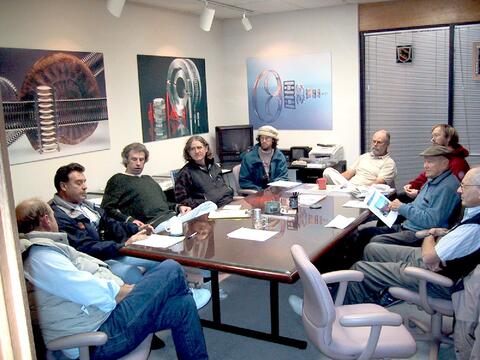
The North Bay meeting begins as Terry Sweet (second from left), of SweetMotors.com makes points about the vehicles he deals with, namely the Corbin Sparrow EV and the new Corbin Merlin roadster, a gas vehicle with a ULEV emissions rating. Notables such as Brian Hall, proprietor ofThunderstruck Motors and fourth from left, Steve Lyons (our host and owner of Sine Electric, at the head of the table), and Nick Carter (NBEAA chapter president, in red) listen and participate in the discussion. On the wall are pictures of rolls and strips of the contacts that go into the Multi-Contact Plug-and-Play connector.
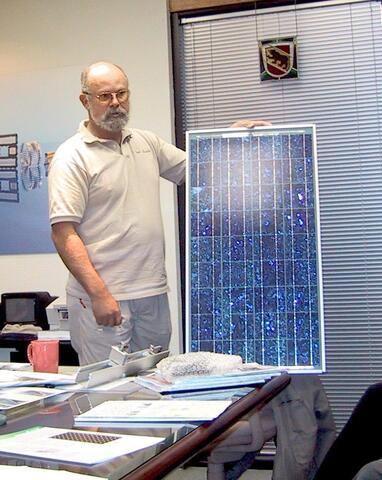
Steve Lyons, owner of Sine Electric, gets down to talking about what he knows best, solar panels and solar installations. Here Steve displays a polycrystalline solar panel.
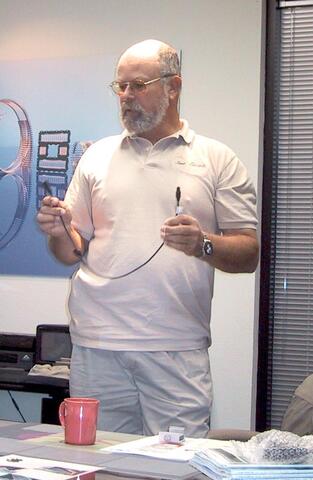
Steve Lyons, owner of Sine Electric, displays one of the Multi-Contact Plug-n-Play solar panel connectors. These connectors provide fast and safe connections to appropriately-configured connection boxes on the back of solar panels. No more tedious wiring of solar panels. No exposure to live connections. The picture on the wall shows strips of the small contacts that are in the ends of these connectors.
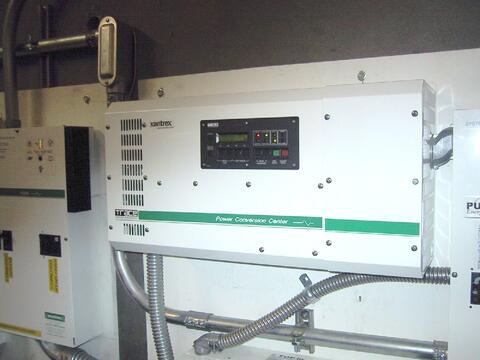
This Xantrex (Trace) grid-intertie inverter is one of the major components of this installation. Its primary purpose is to take direct current (DC) from the solar panels and the battery bank, and invert it to alternating current (AC), a form of electricity that is suitable for running the electrical loads in the Multi-Contact office, and also for putting power back onto the grid.
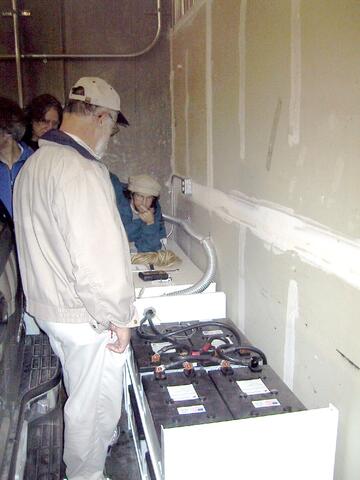
Two banks of four each large lead-acid gell-cell batteries provide energy storage. The batteries are one of three energy “sinks” that use or store energy provided by the solar array and the grid. The other two sinks are the grid itself and the office. The batteries can also be an energy "source", providing energy to either the office or the grid. The energy management system consisting of primarily the inverters and charge controllers (for the batteries) control the flow of energy in this system. Ideally, on sunny days, the solar array will be producing enough power to provide for the office loads, top off the batteries, and send power to the grid. On rainy days or at night, when the power output of the solar array is low, most of the power to run the office will come from the grid. If the grid is out and the solar array is not producing enough, then the major load falls on the batteries. The battery bank needs to be sized correctly to provide enough electrical energy storage to comfortably accommodate office demand for some number of days of grid power outage, say three or four. This entire installation is designed to provide as economically as possible must-have power to keep the Multi-Contact office running.
Related
The NBEAA chapter visited Fetzer Vineyards in Hopland to become acquainted with the business’ 3E environmental program. Patrick Healy, Environmental Manager, and Brad Campbell, Design Engineer, described Fetzer’s electric vehicles (including Ford Ranger EV pickup trucks, NEVs and utility vehicles), organic growing practices, widespread recycling and the use of photovoltaic panels to generate electricity at the site.

In the September 2025 meeting we the new Leaf, Clean Air Vehicle decals cancellation, Clean Cars for All, and more.
Presentation: How healthy are my batteries? — Gerry Glaser

In our March 2025 meeting, we EVA news, Tesla, upcoming Earth Day events, changes to RV park charging, and more.

In our June 2024 meeting, we discussed recent GM vehicles, and solar powered charging.
Presentation: Boat Electrification — Dominic Houlemard

In our May 2024 meeting, we discussed Earth Day event experiences, and recent Tesla developments.
Presentations: Mike Pane from Synergy Solar and Tyson Berg from Greentech Renewables presenting the latest home battery storage and rooftop solar technologies.